


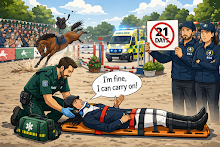
Clearing Head & Spinal Injuries at Equestrian Events: A Clinical Risk That Cannot Be Ignored
- Ashley Redfern
- Apr 12
- 5 min read
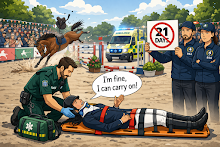
Image: Ashley James Medical (PHEC) Limited. Copyright © 2026. All rights reserved.
This informative blog article is exclusive to Ashley James Medical, and was written by Ashley-James Redfern (CEO & Head of Service).
Equestrian sport is, by its very nature, high-risk. Falls from height, rotational forces, and high-speed impacts mean that head injuries and potential spinal trauma must always be treated as clinically significant and time-critical.
Yet across the UK, a concerning issue persists within event medical provision:
Patients are frequently being assessed and in some cases “cleared” by individuals who are not clinically trained or qualified to do so.
At Ashley James Medical, we believe this represents a serious failure in patient safety, clinical governance, and duty of care.
The Reality on the Ground
Many equestrian events rely on medical providers who deploy a mix of:
First aiders
FREC 3 / FREC 4 personnel
These roles have an important place within a structured team, but it is critical to be clear. They are not trained, qualified, or indemnified to clinically assess, diagnose, or clear head or spinal injuries.
Clearing a rider following a fall, particularly where there is:
Loss of consciousness
Amnesia
High-risk mechanism (e.g. fall from height, axial loading)
Helmet impact
Neck or back pain
…requires advanced clinical decision-making, typically by:
HCPC-registered Paramedics
Doctors
Advanced Clinical Practitioners
Anything less introduces unacceptable clinical risk.
The Clinical Risk: Why This Matters
Head injuries in equestrian sport are often deceptively complex. Even where a rider appears well, they may have sustained:
Concussion / Traumatic Brain Injury (TBI)
Intracranial haemorrhage (e.g. subdural or extradural bleed)
Cervical spine injury or instability
Crucially, symptoms may be delayed, presenting hours or even days later. This is why “Looking fine” does not equate to being clinically safe.
Safe assessment requires:
Structured neurological examination
Mechanism-of-injury analysis
Identification of red flags
Ongoing monitoring and clear safety-netting advice
Mechanism of Injury (MOI): When Immobilisation Must Be Considered
In equestrian incidents, mechanism of injury alone can be sufficient to warrant spinal precautions, even in the absence of immediate symptoms. This is a critical concept often misunderstood or ignored by non-clinicians.
High-risk MOI in equestrian settings includes:
Falls from height (mounted rider ejection)
Axial loading (e.g. landing on head, shoulders, or buttocks)
Rotational falls or being thrown at speed
Horse roll-over or crush injuries
High-velocity impact with ground or fixed obstacles
In these scenarios:
A patient may initially present as alert, ambulatory, and asymptomatic, yet still have a clinically significant spinal injury.
Clinical Approach to MOI
Best practice, aligned with pre-hospital trauma guidance, dictates:
Maintain a high index of suspicion based on MOI
Consider spinal immobilisation or motion restriction where risk is identified
Avoid premature “clearing” of the spine without appropriate clinical assessment
Reassess dynamically as symptoms evolve
Importantly, spinal injury cannot be ruled out purely on the basis of patient presentation at a single point in time.
The Risk of Inappropriate Clearance
Failure to recognise MOI as an independent risk factor may result in:
Missed unstable spinal injuries
Secondary neurological deterioration
Permanent disability
Significant legal and professional consequences
This reinforces a key principle:
MOI is not just background information, it is a clinical decision-making driver.
The Dangerous Myth of “On-Site Clearance”
A common and dangerous practice seen at equestrian events is: “You’re fine — you can get back on.” This is not only clinically unsafe, but may also:
Breach duty of care
Expose organisers to legal liability
Contravene best practice in pre-hospital and sports medicine
Without appropriate clinical governance, documentation, and escalation pathways, this type of decision-making is indefensible.
2026 British Showjumping Concussion Protocol
A Step Change in Rider Safety
From 2026, British Showjumping has introduced significantly strengthened concussion protocols, reflecting a clear shift toward higher standards of safety and accountability.
Key changes include a mandatory 21-day suspension for:
Any rider who is transported to hospital following a fall, or
Is suspected of concussion by medics, officials, or organisers
Formal Suspension Process:
Riders (or guardians) are informed
A concussion card is issued for monitoring
Cross-Governing Body Information Sharing
Suspension details are shared across British Equestrian Federation member organisations, preventing riders from competing elsewhere during suspension.
Return-to-Play Requirements
To reduce the 21-day suspension, riders must provide:
A hospital discharge summary, or
A doctor’s report confirming they are fully symptom-free
Use of SCAT5 Assessment Tool (Suspected concussions are assessed using the SCAT5, a recognised clinical screening tool).
Reassessment Window
Where uncertainty exists, riders may be reassessed after 2 hours. If concussion is confirmed or suspected, the 21-day suspension is enforced.
Why These Changes Matter
These updates are designed to prevent:
Second Impact Syndrome
Premature return to riding
Missed or under-recognised brain injuries
Put simply, returning to sport too early after a head injury can be catastrophic.
The Critical Gap: Who Is Making These Decisions?
While the framework is robust, a crucial issue remains. Who is actually carrying out these assessments on the ground?
Tools like SCAT5 are not standalone decision-makers. They must be used by appropriately trained clinicians with the ability to:
Interpret findings
Apply clinical judgement
Recognise deterioration risk
Make defensible decisions
This is where many event medical providers fall short.
What “Good” Looks Like: Clinical Governance in Practice
At Ashley James Medical, our model is fundamentally different. We operate a clinician-led service, meaning:
Head and spinal injuries are assessed by qualified clinicians only
Decisions are aligned with JRCALC and NICE guidance
Clear escalation pathways to 999 ambulance services are in place
Full documentation and post-incident reporting is completed
Most importantly, we do not “clear” patients beyond our clinical scope, and we never take risks with neurological or spinal injuries.
Booking Professional Medical Cover for Equestrian Events
If you are organising an equestrian event, your medical provision is not just a logistical requirement, it is a critical safety system.
At Ashley James Medical, we provide:
Clinician-led medical teams (Paramedics & advanced practitioners)
Expertise in high-risk sporting environments, including equestrian events
Full alignment with 2026 concussion protocols and national clinical guidance
Robust clinical governance, documentation, and audit processes
Seamless integration with event control, stewards, and emergency services
We do not provide “basic cover”, we provide defensible, professional medical services designed to protect both patients and event organisers.
Request a Quote
To book medical cover for your equestrian event:
Visit: www.ashleyjamesmedical.org.uk
Submit a request via the CareServ Client Portal
Or contact our team directly to discuss your requirements.
When it comes to head and spinal injuries, the quality of your medical provision matters.
Choose a provider that is clinically capable, accountable, and aligned with modern safety standards.
Conclusion
Equestrian sport will always carry inherent risk that cannot be eliminated. However, inadequate medical provision is entirely preventable.
As we move into 2026 and beyond, the direction is clear. Stronger rules, greater accountability, and higher expectations of medical providers.
Event medical care must now be clinically robust, governance-driven, and fit for purpose. Anything less is not just substandard, it is unsafe.


Comments